
Ethyl Acetate vs Butyl Acetate for Manufacturing: An Industrial Procurement Guide
When evaluating ethyl acetate vs butyl acetate for manufacturing, procurement teams often face a critical choice. Both are highly effective, widely used ester solvents, but they are not interchangeable in industrial applications. Whether you are sourcing for high-solids coatings, active pharmaceutical ingredient (API) extraction, or heavy-duty degreasing, selecting the wrong solvent grade or evaporation profile can lead to formulation failures, compliance breaches, or supply chain bottlenecks.
This guide covers the specifications for these 2 solvents that directly affect your purchasing decision, evaporation behaviour, storage classification, regulatory compliance, and documentation requirements, with sourcing notes from BloomchemAG’s supply team where relevant.
What Are Ethyl Acetate and Butyl Acetate?
Before diving into a detailed MSDS comparison of acetate solvents, it is essential to define exactly what you are buying and how these chemicals fit into the broader supply chain.
What Is Ethyl Acetate and How Is It Made?
Ethyl acetate is a highly volatile, fast-drying ester solvent characterized by a distinct fruity odor. It is primarily manufactured by the esterification of ethanol and acetic acid in the presence of a strong acid catalyst. Because its feedstocks bridge both agricultural (grain ethanol) and petrochemical (acetic acid) markets, its availability can be influenced by multiple global sectors.
What Is Butyl Acetate and How Is It Made?
Butyl acetate is a medium-boiling solvent with a noticeably slower evaporation rate. It is produced via the catalytic esterification of n-butanol (derived from the oxo process) and acetic acid. You can explore technical grades for both of these chemicals in our acetyl products portfolio.
Note that acetic acid is a shared feedstock for both solvents – meaning a methanol price spike (which drives acetic acid via carbonylation) will affect both products simultaneously. The independent price variable is n-butanol for butyl acetate versus ethanol for ethyl acetate.
How Are the Two Solvents Chemically Related?
While both are acetate esters, a crucial distinction must be made for procurement agents: in global trade, “butyl acetate” by default means n-butyl acetate. Isobutyl acetate and sec-butyl acetate are entirely distinct isomers with different evaporation curves, solvency profiles, and pricing structures. Ordering the wrong isomer is an expensive procurement error. Always confirm you are sourcing the n-butyl isomer unless your formulation specifically dictates otherwise.
When requesting quotations, always specify n-butyl acetate explicitly in writing. CAS number 123-86-4. Do not rely on “butyl acetate” alone in a PO – suppliers in some markets default to isobutyl acetate (CAS 110-19-0) when the isomer is unspecified.
Ethyl Acetate vs Butyl Acetate for Manufacturing: How Do the Physical Properties Compare?
The core difference between these two chemicals is how quickly they flash off and how aggressively they dissolve target resins.
How Do the Boiling Points of Ethyl Acetate and Butyl Acetate Differ?
The boiling point of ethyl acetate vs butyl acetate is often the first metric buyers check. Ethyl acetate boils at roughly 77°C, while n-butyl acetate boils much higher, at approximately 126°C. However, boiling point is only a rough guideline for how a solvent will behave on a production line.
Boiling point is useful for setting distillation recovery temperatures in closed-loop solvent recovery systems, but it should not be your primary evaporation spec for open-process applications. Use vapor pressure for that.
What Does Vapor Pressure Tell You About Each Solvent?
Real evaporation behavior runs on vapor pressure, not boiling point. When doing a vapor pressure comparison of acetate solvents, the data is stark. At 20°C, ethyl acetate has a vapor pressure of ~97 mmHg, whereas butyl acetate sits at just ~15 mmHg. At standard production temperatures (30°C to 35°C), this gap widens significantly. If your process requires rapid drying, you cannot rely on boiling point alone; vapor pressure dictates the actual line speed.
Industry standards quantify this using a relative evaporation rate where n-butyl acetate is set as the baseline (1.0). By comparison, ethyl acetate has an evaporation rate of ~4.1. This means ethyl acetate evaporates roughly four times faster—a figure that commonly appears on Technical Data Sheets (TDS) and is the primary spec formulation teams reference.
How Does Molecular Weight Affect Solvent Performance?
Ethyl acetate has a molecular weight of 88.11 g/mol; n-butyl acetate is 116.16 g/mol. The practical consequence for procurement is VOC calculation: regulatory VOC limits are expressed in g/L, and a solvent’s molecular weight directly affects how VOC compliance is calculated for your formulation.
Higher molecular weight means fewer moles per unit volume, which can work in your favour depending on how your formulation’s VOC limit is structured. If your product is subject to EU Directive 2004/42/CE VOC limits, verify the calculation method with your formulator before switching solvents.
What Is the Difference in Polarity and Solubility Between the Two?
When assessing the polarity of ethyl acetate vs butyl acetate, Hansen Solubility Parameters (HSP) provide the exact specifications required by chemists. The key specification is the polar component ($\delta_p$). Ethyl acetate has a $\delta_p$ of ~5.3 MPa½, making it highly polar and aggressive. Butyl acetate has a lower $\delta_p$ of ~3.7 MPa½.
Furthermore, looking at Kauri-Butanol (KB) values—a standard measure of solvency power—ethyl acetate scores an ~83, while butyl acetate scores an ~71. While ethyl acetate has stronger solvency on paper, butyl acetate’s slower evaporation keeps it active longer in formulations like high-solids coatings, preventing premature skinning.
A practical implication: if your resin system was developed and qualified using ethyl acetate, switching to butyl acetate is not a like-for-like substitution. The δp gap (5.3 vs 3.7 MPa½) is large enough to alter resin dissolution rates, which changes your formulation’s pot life and application window. Run a lab trial before any grade switch.
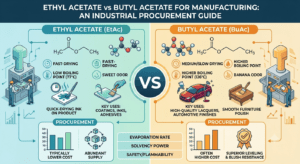
Ethyl Acetate vs Butyl Acetate: Side-by-Side Property Breakdown
|
Property |
Ethyl Acetate |
n-Butyl Acetate |
|
UN Number (Transport) |
UN 1173 |
UN 1123 |
|
Boiling Point |
~77°C |
~126°C |
|
Packing Group |
II |
III |
|
Vapor Pressure (20°C) |
~97 mmHg |
~15 mmHg |
|
Evaporation Rate (BuAc=1.0) |
~4.1 |
1.0 |
|
Flash Point |
-4°C |
~22°C |
|
NFPA 30 Storage Class |
Class IB |
Class IC |
|
KB Value |
~83 |
~71 |
|
HSP Polar Component ($\delta_p$) |
~5.3 MPa½ |
~3.7 MPa½ |
|
Primary Industry Focus |
Extraction, fast-dry inks |
Coatings, smooth finishes |
Quick Decision Matrix
|
Your Application |
Recommended Solvent |
Primary Reason |
|
Pharmaceutical API extraction |
Ethyl Acetate |
Higher polarity, better water separation, faster residue removal |
|
High-solids industrial coatings |
Butyl Acetate |
Slow evaporation enables levelling; prevents orange-peel |
|
Fast-drying wood lacquers / flexo inks |
Ethyl Acetate |
High evaporation rate matches line speed |
|
Heavy oil/grease degreasing |
Butyl Acetate |
Extended dwell time needed to dissolve substrate |
|
Electronics/precision metal cleaning |
Ethyl Acetate |
Fast flash-off, no residue |
|
Flexible packaging adhesives |
Ethyl Acetate |
High polarity dissolves PU/NC resins; fast lamination speed |
|
Nail polish formulation |
Blend (both) |
EA for fast initial dry, BA to maintain brushability |
Need the specification sheet for either grade before committing to volume? Request it from BloomchemAG’s supply team – industrial and pharmaceutical grade COA available on request.
Where Is Each Solvent Used Across Industries?
Choosing which acetate solvent is better depends entirely on the end-use application and the required drying curve.
Which Acetate Solvent Works Better for Paints and Coatings?
When sourcing acetate solvents for paints and coatings, butyl acetate is the industry favorite. Its slower evaporation rate allows high-solids paints to level out properly, resulting in a smooth, glossy finish without blushing (moisture trapping) or orange-peel defects. Ethyl acetate flashes too quickly for most topcoats but is used in fast-drying wood lacquers.
Which Is Preferred in Pharmaceutical Manufacturing?
For pharmaceutical procurement, both ethyl acetate and butyl acetate are listed as ICH Q3C Class 3 solvents – a designation indicating low toxicity potential under GMP-managed conditions. Their individual Permitted Daily Exposure (PDE) values differ: ethyl acetate is set at 117 mg/day, butyl acetate at 83.3 mg/day (per ICH Q3C R6/R9). Both require standard Class 3 residual solvent testing and documentation. Neither of the 2 triggers the elevated risk assessment process required for Class 1 or Class 2 solvents.
The practical reason ethyl acetate dominates pharmaceutical extraction is process chemistry, not regulatory classification. Its higher polarity (δp 5.3 MPa½) and better water-partition behaviour make it significantly more effective at pulling target compounds out of aqueous reaction mixtures and then separating cleanly. It also leaves lower residual levels in the dried API because it evaporates faster and more completely under standard drying conditions.
For your documentation requirements: COA for pharmaceutical-grade ethyl acetate must include purity (≥99.5% for pharma grade), water content (≤0.03%), acidity as acetic acid, colour (APHA), and residue on evaporation. Butyl acetate used in pharma processes requires the same COA parameters. Neither is documentation-interchangeable with industrial grade.
Which Solvent Performs Better in Industrial Cleaning Applications?
The choice of industrial cleaning solvents comes down to soil types. Ethyl acetate is utilized for quick-wipe applications where the surface must be immediately ready for processing (e.g., electronics or precision metal). Butyl acetate is preferred when dissolving heavy oils, greases, or uncured resins, as its lower volatility provides the necessary dwell time.
Which Solvent is Best for Adhesives and Sealants?
Ethyl acetate is a primary solvent in flexible packaging adhesives and contact cements. Its high polarity easily dissolves polyurethane and nitrocellulose resins, and its rapid flash-off allows high-speed lamination lines to run efficiently without trapping solvent inside the bonded layers.
For solvent-borne polyurethane adhesives specifically, verify with your supplier that residual isocyanate content in the ethyl acetate is within spec. This is occasionally an issue with lower-grade industrial material and will affect your laminated product quality.
What Are the Key Challenges and Handling Considerations?
Procurement is not just about price; logistics, storage, and regulatory compliance heavily dictate landed costs.
What Are the Flammability and Safety Risks of Each Solvent?
Storage classifications directly impact warehouse infrastructure. Ethyl acetate has a dangerously low flash point of -4°C, classifying it as an NFPA 30 Class IB flammable liquid. Butyl acetate has a flash point of ~22°C, making it a Class IC liquid. The lower flash point of ethyl acetate means stricter warehouse designs, specialized sprinkler requirements, and potentially higher insurance premiums.
For warehouse operators: the Class IB designation for ethyl acetate typically requires flammable storage cabinets rated to FM or EN 14470-1 standard, separated from Class IC storage. If you are storing both solvents on the same site, verify your warehouse layout complies with local fire authority requirements before the first delivery arrives, not after.
How Do Costs Compare Between Ethyl Acetate and Butyl Acetate?
The ethyl acetate price vs butyl acetate ratio is rarely static because they rely on different supply chains. Ethyl acetate pricing tracks the ethanol and acetic acid markets. Butyl acetate tracks the n-butanol (oxo alcohol) market.
Because the key price drivers diverge – ethanol and acetic acid for ethyl acetate; n-butanol and acetic acid for butyl acetate, a cost advantage in one solvent today may reverse within a quarter. Note that acetic acid, a shared feedstock, means both products are partially correlated: a methanol market spike that drives acetic acid prices up will pressure both simultaneously. For bulk buyers on multi-month contracts, ask your supplier to flag feedstock index movements in your pricing update cadence, not just final price.
What VOC and Regulatory Requirements Should You Know About?
Both solvents are classified as Volatile Organic Compounds under EU Directive 2004/42/CE and the Industrial Emissions Directive (2010/75/EU). VOC limits for your finished product category govern how much of either solvent your formulation can contain, not whether you can use them, but at what concentration. Molecular weight matters here: the VOC calculation (g/L of solvent in the coating) is affected by density and molecular weight, so switching between the two is not VOC-neutral even at the same volume.
For REACH purposes, both substances are registered under ECHA. Neither is currently on the SVHC candidate list. Verify SDS currency (Regulation (EC) 1272/2008, CLP) before accepting a shipment. SDS revision dates matter for your own downstream labelling obligations.
How Do Transport Codes (ADR/IMDG) Differ?
Due to their differing flash points, transport regulations vary. Ethyl acetate requires stricter ADR (road) and IMDG (maritime) coding for highly flammable liquids, impacting freight costs and limiting which carriers can legally transport your bulk loads.
Ethyl acetate ships as UN 1173, Class 3, Packing Group II under both ADR (road) and IMDG (sea). Butyl acetate ships as UN 1123, Class 3, Packing Group III. Packing Group II for ethyl acetate means stricter requirements for IBC tank selection, carrier licensing, and placarding. Confirm UN classification with your logistics provider before booking as incorrect classification is a common cause of freight rejection at port.
How Do You Make the Right Buying Decision Regarding Ethyl Acetate vs Butyl Acetate for Manufacturing?
Procuring a bulk acetate solvent requires aligning chemical properties with supply chain realities.
Should You Choose Based on Price Alone?
No. If you buy ethyl acetate purely because it is cheaper per metric ton, but your coatings require the leveling properties of butyl acetate, the resulting product defects will cost far more than the savings. Always match the evaporation curve to your technical requirements first.
When Should You Consider Propyl Acetate as an Alternative?
If ethyl acetate flashes too fast, but butyl acetate slows down your line speed too much, comparing propyl acetate vs butyl acetate is the next logical step. Propyl acetate sits directly in the middle regarding evaporation rate and flash point, offering an excellent compromise for specific printing inks and OEM coatings.
What Should You Test Before Committing to Bulk Volume?
Never switch from an ethyl acetate vs butyl acetate solvent without running a pilot batch. Because the solvency ($\delta_p$) and evaporation rates (4.1 vs 1.0) differ so vastly, a direct drop-in replacement will alter the viscosity, drying time, and final finish of your formulation.
What Documentation Should You Demand from Suppliers?
For any bulk order, demand a rigorous Certificate of Analysis (COA). Standard industrial grades demand 99%+ purity. Your COA must verify water content, acidity (measured as acetic acid), color (APHA), and residue on evaporation. For pharmaceutical or food-grade applications, tolerances for these trace impurities are significantly tighter.
Need help navigating solvent specifications? Speak to a sourcing specialist or contact our supply team to align your technical requirements with global availability.
Conclusion
Choosing between ethyl acetate and butyl acetate comes down to three variables: your required evaporation speed (check vapor pressure, not boiling point), your resin compatibility (check HSP polar component, not just KB value), and your regulatory and transport classification requirements (both are ICH Q3C Class 3; they differ at NFPA storage and ADR packing group level).
Neither solvent is universally better. Ethyl acetate wins where speed and polarity matter – extraction, fast-drying inks, flexible packaging adhesives. Butyl acetate wins where controlled drying is required – high-solids coatings, heavy-substrate degreasing.
If you are evaluating bulk volumes of either solvent, partnering with a reliable Global Chemical Distribution Company which can provide COA documentation, feedstock price trend updates, and specification sheets for both industrial and pharmaceutical grades can be an asset. Contact us to align your technical requirements with current availability.
Frequently Asked Questions
Q1: Can ethyl acetate and butyl acetate be blended together?
Yes. The two solvents are fully miscible and are frequently blended by formulators to fine-tune evaporation speeds and solvency parameters. Always test the blend in your specific resin system first.
Q2: Which is safer to store: ethyl acetate or butyl acetate?
Butyl acetate is generally easier to store safely. It has a higher flash point (~22°C) and falls under NFPA Class IC, whereas ethyl acetate’s low flash point (-4°C) places it in the stricter Class IB, requiring more rigorous fire suppression controls.
Q3: Does purity grade matter when choosing between the two acetates?
Yes, and it’s one of the most common procurement errors. Industrial grade (≥99% purity) is acceptable for coatings, inks, and cleaning. Pharmaceutical grade requires tighter tolerances on water content (≤0.03%), acidity, heavy metals, and residue on evaporation, and must be produced under GMP-compliant conditions with full batch traceability. Using industrial grade in a pharma process is not just a quality risk – it is a regulatory compliance failure. Always specify grade in your PO, not just purity percentage.
Q4: Which solvent works better in nail polish formulations?
Both are used, often in combination. Ethyl acetate provides the fast initial dry time, while butyl acetate is added to keep the polish fluid enough to brush smoothly onto the nail before skinning over.
Q5: Is ethyl acetate or butyl acetate better for extraction processes?
Ethyl acetate is overwhelmingly preferred for extraction, particularly in pharmaceuticals and decaffeination, due to its high polarity, excellent water-partition behaviour, and faster residue removal under standard API drying conditions. Both solvents are ICH Q3C Class 3; the preference for ethyl acetate in extraction is process chemistry, not regulatory classification.
Q6: Can butyl acetate directly replace ethyl acetate in an existing formulation?
No. Because butyl acetate evaporates about four times slower and has a lower polarity, a direct 1:1 replacement will drastically alter drying times, viscosity, and potentially resin compatibility.
Q7: Which acetate solvent has lower VOC emissions?
Both are considered Volatile Organic Compounds (VOCs) and contribute to emissions. However, because butyl acetate evaporates more slowly, its instantaneous emission rate in an open environment is lower than the highly volatile ethyl acetate.
For VOC compliance calculations under EU Directive 2004/42/CE, the relevant figure is g of VOC per litre of product. Switching from ethyl acetate to butyl acetate changes this calculation even at equal volumes due to their different molecular weights and densities. Verify with your formulator.
Q8: How does temperature affect ethyl acetate and butyl acetate performance?
As ambient temperatures rise (e.g., moving from 20°C to 35°C in a summer production facility), the vapor pressure of ethyl acetate spikes aggressively, causing it to flash off too quickly. Butyl acetate is more stable across normal temperature fluctuations.
Q9: Which solvent is better for adhesive manufacturing?
Ethyl acetate is generally preferred in flexible packaging and polyurethane adhesives because its rapid evaporation allows high-speed manufacturing lines to bond materials quickly without trapping wet solvent.
Q10: What should I check before buying acetate solvents in bulk?
Always verify that you are buying the correct isomer (n-butyl vs isobutyl), demand a COA to check water and acidity levels, confirm regulatory compliance for your industry (like pharma PDE limits), and conduct a lab trial before committing to full tankers.